Choosing between options is one of the most important HVAC decisions a Greater Vancouver homeowner makes. This guide breaks down single-stage vs two-stage furnace in plain language so you can decide with confidence — and ROMA Heating & Cooling can give you a free, tailored recommendation for your home.
The key differences
Each option has trade-offs in upfront cost, operating cost, comfort and suitability for different homes:
- Upfront cost and installation requirements
- Monthly operating cost in BC’s energy market
- Comfort and consistency across the home
- Suitability for your home’s age, layout and ductwork
- Available FortisBC and CleanBC rebates
- Lifespan and maintenance needs
What’s usually best for Greater Vancouver homes
Our mild, damp climate often favours high-efficiency systems, and heat pumps have become a strong option for many Metro Vancouver homes thanks to rebates and low operating costs. The right choice still depends on your home — ductwork, layout, budget and how you use each room all matter.
Get a free recommendation from ROMA
ROMA Heating & Cooling has served Greater Vancouver homeowners since 1999. We’re a TSBC-licensed gas contractor (LGA0202903), fully bonded and insured, with Red Seal–trained technicians, a 4.8-star rating from 158+ Google reviews, upfront flat-rate pricing and 0% financing (OAC). Call (604) 704-0300 for a free, no-obligation assessment.
What Our Customers Say
“I had no heat and after three other companies failed to fix my furnace, a friend recommended Roma Heating.”
— Sima Mann, Google review (★★★★★)
“My furnace stopped working right when the weather dropped and they managed to fit me in the prompt.”
Rather have a licensed pro handle it? Fast, honest help across Greater Vancouver.Call (604) 704-0300Free Estimate— Tj Max, Google review (★★★★★)
Frequently Asked Questions
Which is better for my home?
It depends on your home’s layout, existing ductwork, budget and comfort priorities. We provide a free in-home assessment and an honest recommendation — no pressure.
Are there rebates available?
Often yes — FortisBC and CleanBC offer rebates on qualifying high-efficiency equipment. We help you find and claim what’s available.
Is financing available?
Yes — ROMA offers 0% financing (OAC) so the right system fits your budget.
How do I get an accurate quote?
Call (604) 704-0300 for a free assessment. We size the system to your home and give you a clear, flat-rate quote.
Related Services
- Furnace Not Heating
- Prompt No-Heat Furnace Repair
- Furnace Control Board Error Codes
- Furnace Tune-Up
- Goodman Furnace Error Codes
- Furnace Troubleshooting & Repair
Call ROMA Heating & Cooling Today
For fast, professional diagnosis and repair anywhere in Greater Vancouver, call (604) 704-0300 or email info@romaheating.ca. prompt and after-hours service, gas-licensed and insured, serving the Lower Mainland since 1999.
Should a Greater Vancouver home get a single-stage or a two-stage furnace?
For most detached homes here, two-stage is the better buy for comfort, while single-stage still suits small, tight spaces. In matched Trane and American Standard pairs, both versions list the same up to 96.0% AFUE, so you are paying for gentler, longer heating cycles, not a better rating. York’s pair differs slightly: 96% against 95%.
The complaint that starts this conversation is nearly always the same: “it roars on, blasts hot air, shuts off, and a little later does it all again.” That is what a single-stage furnace does by design. It has one setting, full fire. A two-stage furnace adds a lower setting that it uses most of the time. To show what that second stage changes on paper, we lined up three same-brand pairs where staging is the main published difference and the blower type stays the same within each pair.
What do matched single-stage and two-stage pairs show on paper?
Within each brand, moving from single-stage to two-stage leaves the blower type unchanged and, for Trane and American Standard, the AFUE unchanged as well. The York pair shows a small rating gap and a different published input range. Warranty terms are identical within each pair.
| Brand | Single-stage model | Two-stage model | AFUE (single / two) | Blower (both) | Input (single / two) | Warranty (both) |
|---|---|---|---|---|---|---|
| Trane | 96 Single-Stage | 96 Two-Stage (formerly S9X2) | up to 96.0% / up to 96.0% | not variable-speed | — / — | lifetime limited on heat exchanger and 10-year limited on internal functional parts with registration within 60 days (residential use only); otherwise Base Limited Warranty applies |
| American Standard | S9X1 | S9X2 | up to 96.0% / up to 96.0% | not variable-speed | — / — | lifetime limited on heat exchanger + 10-year limited on functional parts, with registration within 60 days (else Base Limited Warranty) |
| York | LX TM9E | LX TM9Y | 95% / 96% | high-efficiency blower (not variable-speed) | 26-120 MBH / 40-120 MBH | lifetime heat exchanger + 10-year parts with online registration within 90 days; otherwise 20-year heat exchanger and 5-year parts |
Some document details to keep in mind. Trane’s figures come from a 2024 U.S. brochure (72-1340-09); the brochure prints “Formerly L9X1” for the single-stage model, and Trane has moved its S-series to descriptive names. American Standard notes that registration and transfer exclusions vary by province in Canada. For the York TM9E, the current LX Series brochure lists 95% and 26-120 MBH, while an older brochure listed 95.5% and 40-120 MBH; specifications vary by document. York lists ENERGY STAR on both of its models; the Trane and American Standard documents we used do not state it.
If the ratings match, what does the second stage actually buy?
It buys comfort and quieter operation. A two-stage furnace starts on its low setting and stays there through most mild weather, producing longer, gentler cycles. You get fewer temperature swings, less of the hot-blast feeling at the registers and less stop-start wear.
The Trane and American Standard pairs make that point sharply: identical AFUE ceilings, identical blower type, identical warranty language. The only published change is the burner. So if a quote prices the two-stage version higher, the extra is for how the house feels, not for efficiency on the label. In York’s pair, the two-stage TM9Y also lists a slightly higher rating at 96% against the TM9E’s 95%.
The York input ranges show a nuance as well. The single-stage TM9E’s current brochure lists inputs from 26 MBH, while the two-stage TM9Y starts at 40 MBH. For a very small, well-insulated space, the smallest single-stage size can sometimes match the heat load more closely than the smallest two-stage size. That is why the heat-loss calculation, not the brochure, makes the final call.
How does the Lower Mainland climate tip the choice?
Our weather favours two-stage. Heating season here is long, cool and wet, with a handful of colder outflow days most winters. A two-stage furnace runs its low setting through the drizzle and saves full fire for the cold snaps; a single-stage unit uses full fire for both.
Two-stage operation also helps the classic Vancouver Special or older two-storey home, where the upstairs runs warm and the basement stays cool. Longer cycles keep air moving through the ducts for more of the evening, which evens things out. In a small strata townhouse with short duct runs, though, a correctly sized single-stage furnace can be perfectly comfortable. Both kinds here are condensing furnaces with plastic venting and a condensate drain; in our soft-water region, neglected traps fill with sediment and debris rather than scale, so they belong on the yearly service list. If your current furnace is already short-cycling, a furnace repair visit can tell you whether sizing or a fault is the cause.
Which homes are better served by each type?
- Detached two-storey homes and Vancouver Specials: two-stage, such as the Trane 96 Two-Stage, American Standard S9X2 or York TM9Y.
- Homes with a finished basement bedroom near the furnace: two-stage, for its softer low-fire operation.
- Small townhouses, coach houses and basement suites: single-stage, such as the Trane 96 Single-Stage, American Standard S9X1 or York TM9E, if it sizes correctly.
- Buyers who need an ENERGY STAR label for a program: York lists it on both the TM9E and TM9Y; check the current program rules first.
One more point owners ask about: noise from the burner itself. On a single-stage furnace, ignition at full fire is the loudest moment of every cycle, and it repeats many times on a cold evening. A two-stage furnace still lights, but it usually lights on low and runs far longer before shutting off, so those ignition moments come less often. None of these manufacturers publishes a sound figure, so treat this as how the design behaves, not a measured claim.
How does ROMA recommend one over the other?
We base it on the house. A technician calculates heat loss room by room, checks ducts, venting and gas supply, and then prices both a single-stage and a two-stage option in a written flat-rate quote so the difference is clear.
- Room-by-room heat loss, so the smallest available size is matched correctly.
- Duct layout and return air, which shape how well longer cycles work.
- Thermostat type; a two-stage furnace performs best with a control that can call for each stage.
- Vent route, termination clearances and strata approvals where they apply.
- Gas line sizing and permits through Technical Safety BC or the City of Vancouver.
ROMA has served Metro Vancouver since 1999 as a TSBC-licensed gas contractor (Gas LGA0202903), bonded and insured, from our office in Burnaby seven days a week. Installation estimates are free and financing is available OAC. Call (604) 704-0300, email info@romaheating.ca or book your free estimate.
Safety: smell gas? Get out, leave switches off, and call FortisBC’s emergency line and 911 from outside. If a CO alarm sounds or anyone has a headache or nausea, leave the house and call 911.
Sources
- Trane U.S. furnace brochure 72-1340-09, 2024 (www.trane.com), retrieved November 2026
- American Standard furnace brochure (americanstandardair.com), retrieved November 2026
- York LX Series consumer brochure (www.yorknow.com), retrieved November 2026
Specifications change; confirm the current model’s rating plate and spec sheet before you buy.
More questions we hear about this
Is a two-stage furnace worth it over single-stage?
In most Greater Vancouver detached homes, yes, for comfort. In the Trane and American Standard pairs we compared, single-stage and two-stage models list the same up to 96.0% AFUE, so the benefit is not a higher rating. It is longer, gentler cycles on low fire during mild, wet weather, with fewer temperature swings and less stop-start noise.
Does a two-stage furnace use less gas?
The published ratings in our matched pairs do not show it. Trane's and American Standard's single-stage and two-stage models both list up to 96.0% AFUE, while York lists 95% for its single-stage TM9E and 96% for its two-stage TM9Y. Real-world use depends on sizing, ducts and thermostat settings, so we do not estimate savings.
When is a single-stage furnace the right choice?
A single-stage furnace makes sense in small, well-sealed spaces with short duct runs, such as compact townhouses, coach houses or basement suites, when it is sized from a heat-loss calculation. It has one firing rate, so oversizing causes short cycles. York's current brochure lists its single-stage TM9E with inputs starting at 26 MBH, useful for small loads.
Do registration rules differ between these furnace brands?
Yes. Trane and American Standard call for registration within 60 days for their lifetime limited heat exchanger and 10-year functional parts terms, and American Standard notes exclusions vary by province in Canada. York requires online registration within 90 days; otherwise its terms become 20-year heat exchanger and 5-year parts. Register promptly and keep the confirmation.
What Greater Vancouver Homeowners Say
“Nelson worked hard to get the NTI unit fixed. He was always polite, courteous and on time.”
“As always Nelson was super efficient. Showed up on time and was quick to work. I had a full maintenance done on the fireplaces and furnace. He was awesome. I won’t use anyone else.”
“Excellent service. Andy had a spare Carrier inducer with him which saved us time.”
“Was very prompt to respond to our issues. Technician was scheduled for the day following my initial call.”
“Very professional heating company. Price is reasonable, excellent work.”
“Highly recommend this company. It was a pleasure dealing with Shawn and Nelson.”
“Professional and courteous technicians with attention to detail and customer needs.”
“Always great, friendly service. Serviced the hot water on-demand system. Honest and informative. Thanks!”
“Speedy response time, honest, and professional service from start to finish.”
Why Greater Vancouver Trusts ROMA Heating & Cooling
ROMA Heating & Cooling has installed, repaired and maintained heating and cooling systems across Metro Vancouver since 1999. Our team are TSBC-licensed gas fitters (Gas LGA0202903) and Red Seal-trained technicians — licensed, bonded and insured — and we back every job with upfront, flat-rate pricing and a 100% satisfaction guarantee. We hold a 4.8★ rating from 221+ Google reviews.
- Authorized for 30+ brands (Lennox, Carrier, Viessmann, Navien, Rheem & more)
- Upfront flat-rate pricing — no overtime or hidden fees
- Free, no-obligation estimates on new installations
- Locally owned & operated in Burnaby, BC
No Hidden Fees
Our service rates are transparent and easy to understand. You approve upfront, flat-rate pricing before we start — so you never get a bill you didn’t expect.
Licensed & Bonded
ROMA is a TSBC-licensed gas contractor (Gas LGA0202903). Our technicians are bonded, insured and Red Seal-trained — qualified for any heating or cooling system.
Free Estimates
We offer free, no-obligation estimates on new installations — furnaces, boilers, heat pumps, air conditioners, tankless and hot-water tanks.
ROMA Heating & Cooling is a trusted HVAC contractor serving Metro Vancouver since 1999. We specialize in furnace repair, heat pump installation, boiler services, air conditioning, and emergency heating solutions for residential, commercial, and government clients. Available for same-day and after-hours service, our certified technicians deliver fast, reliable, and affordable HVAC services across Greater Vancouver.
More ROMA services in Vancouver
Part of our Gas Furnace Guide: Everything Metro Vancouver Homeowners Need to Know › Furnace types & efficiency
Related guides in this topic:
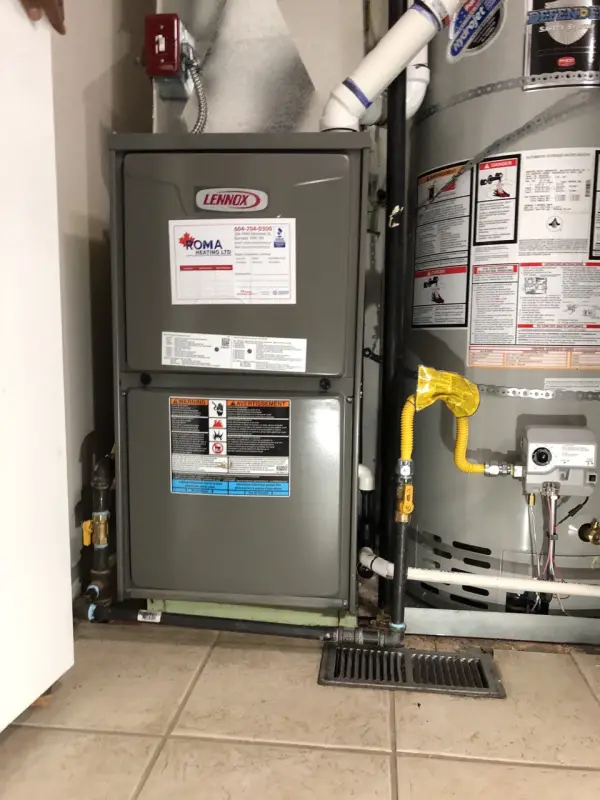
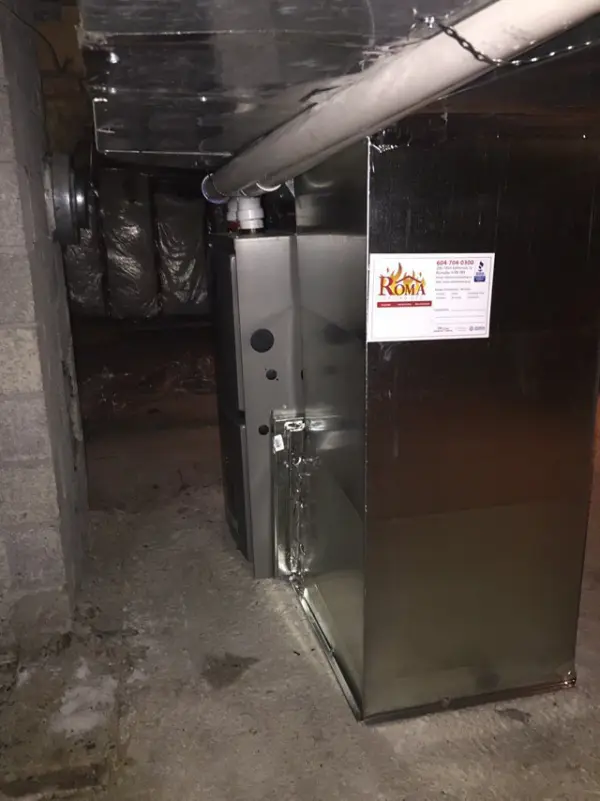
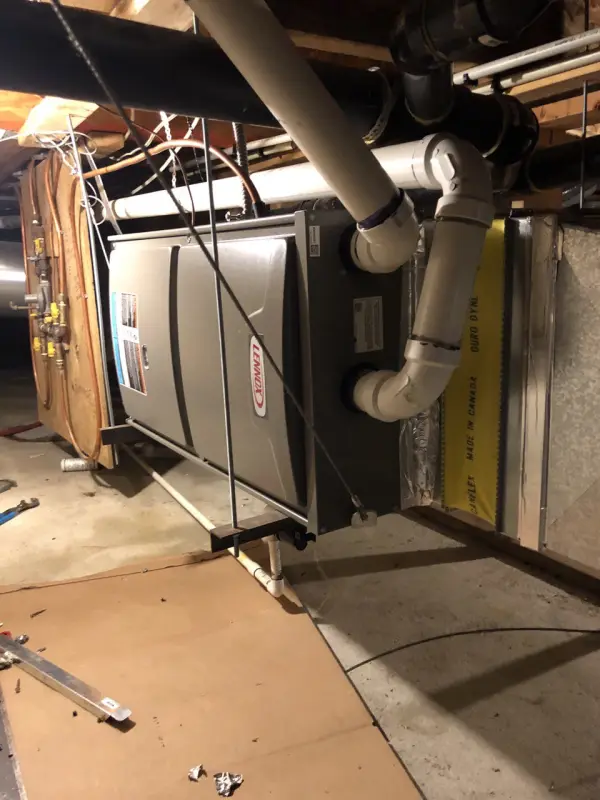
Real ROMA furnace work. These photos are from our own jobs, not stock images. See more in our work gallery or call (604) 704-0300.