Call for heat: the air pushes cool. Look at the thermostat: it says heat. Somewhere between the button and the machine, the message got translated wrong. On a dual fuel heat pump and gas furnace, the translator is the low voltage wiring — the thin control cables that carry the calls between the thermostat, the heat pump’s board, and the furnace’s board. When it stumbles, the wrong mode answers: a loose terminal breaks the call, a shorted pair flips the circuit, damaged cable drags the line down, and a board that should be firing heat gets a signal it can’t sort out. Low voltage does not carry the power that kills you — but it carries the truth, and the truth matters. If the house drops away while the register stays cool, switch to the gas furnace manually, and if the furnace is involved, the safety line holds: CO alarm working; gas smell means out, FortisBC emergency, 911.
ROMA Heating & Cooling — licensed, TSBC-registered (Gas LGA0202903) — verifies terminations, continuity and the mode path, across our furnace repair and heat pump service spread. (604) 704-0300.
What does the low voltage wiring actually carry?
Not power — messages. The heat pump sends its status, the furnace’s board reads the staging calls, the thermostat speaks for you, and the wiring carries all of it from box to box at handfuls of volts. On a hybrid there are more conversations than on a single machine: the heat pump has a call, a mode, and a changeover line; the furnace has its own stage calls. Every one of those lines is a wire someone terminated. A classic field detail: technicians watch the wires near a cold evaporator cabinet for condensation corrosion on the terminals, because the cooling side’s moisture does its work on even the best-installed junction.
What causes problems with the low voltage wiring when a dual fuel heat pump and gas furnace blows cool air in heating mode?
Call a licensed ROMA gas technician — (604) 704-0300
| Wiring fault | What it breaks | Why the answer is cool air |
|---|---|---|
| Loose terminals | The call between thermostat and board | The board sits in its last known — often cooling — state |
| Shorts and crossed pairs | Mode and stage lines confused | Heat call answers on the cooling circuit |
| Damaged cable runs | Signal quality along the route | Messages drop; the system defaults instead of heating |
| Corroded connections | Resistance where there should be none | Intermittent mode failures, worst in damp weather |
Why is the wiring more influential on a hybrid than a single machine?
Because the hybrid shares one thermostat between two machines with two mode sets and a changeover rule. A single-machine system that loses a wire just fails to answer; the hybrid can answer wrong — the heat pump in cooling, the furnace never staged, the changeover line reading a circuit that isn’t telling the truth. The symptom set is richer, which makes the wiring story more common and more often misstaged. The technician’s read begins at the board’s terminals and walks the route, not at the thermostat’s wall plate.
What does a technician verify on this circuit?
- Terminations at the thermostat, the control board, and the outdoor unit.
- Continuity on the heating call and the mode wires.
- Voltage at the board with the system calling for heat — in both modes.
- Any damaged or animal-affected cable runs between the boxes.
- The mode the board actually holds, versus the mode it was told to hold.
Is the cool air a safety issue?
Comfort is the immediate story; safety enters when the gas side is involved — and the hybrid always has the gas side. The furnace board’s safety design is closed and self-checking; the correct owner response is the gas smell test, the CO alarm check, and getting a technician into the wiring read sooner rather than later. ROMA Heating & Cooling separates wiring from machine in the same visit — one booking, both machines.
How does ROMA Heating & Cooling read cool air when a wiring story is suspected?
Step by step, in order: the thermostat’s call, the wire’s delivery, the board’s answer. The read decides, and the verdict is usually a terminal, a splice, or a run — found and fixed on the visit, with the machine’s mode re-proven before the truck rolls. Tell us what you have — the brand, the model, and what it’s doing — and we’ll come back with the honest picture. Call (604)
The wiring story has a winter accent: the same loop that works in April can mispeak in December, because the winter’s call is harsher and the machine’s demands on the wires are heavier. That is why the read is scheduled in the season the symptom shows, not in the service’s off-month, and why the heating call’s continuity is verified under a real cold-cycle load rather than an open air test.
What questions does the read ask?
- Does the heat call’s voltage hold at the board when the house is asking?
- Which mode line is alive, and which sits idle?
- Where along the route does the signal weaken — the wall, the junction, or the unit?
- Have the terminals seen corrosion’s colour, or the wires’ insulation any chafe?
The four answers place the fix’s point: the stat’s terminal block, a splice mid-run, or the board’s edge connector. The visit’s verdict then names the exact spot, and the repair is the few inches where the truth was lost.
Need a licensed gas technician in Greater Vancouver?
ROMA Heating & Cooling has served Metro Vancouver since 1999 — TSBC-licensed (Gas LGA0202903), bonded & insured, 4.8★ from 221 Google reviews. Upfront flat-rate pricing, free estimates on installs, 0% financing (OAC), no hidden fees, 7 days a week.
Frequently Asked Questions
What counts as low voltage wiring on a heat pump and furnace?
The control cable set: the wires between the thermostat and the units’ boards, plus the connections inside each cabinet. On a dual fuel system it also includes the changeover signal between the heat pump and the furnace integration. It does not carry the line power for the machines.
Could a loose thermostat wire really make the system blow cool air?
It can, and it is a common entry: a loose terminal on the heat call leaves the board uncertain, and the board runs what it can hold — often the last mode it saw. The thermostat reads heat, the wire loses the message, and the register reports the mismatch.
Can I test the low voltage wiring myself without touching the boards?
The safe owner line is the thermostat check and the breaker label. Metering the wire runs and re-terminating belongs in the hands of a technician — the voltages are low, but the stories they carry are the diagnostic’s foundation. A wrong assumption there costs a replacement decision that the wiring could have saved.
Why does the cool air happen only on some winter days?
Weather lines up with the fault: cold days run defrosts and long cycles, and a marginal wire’s fault appears when the system works hardest. Damp spells soften corrosion stories. The pattern — worse when it’s cold, foggy, or after a rain — is a classic clue that the wiring side is the author.
Would a battery-backed thermostat change the wiring story?
The thermostat’s power doesn’t rewire the house — a battery-backup stat still needs the control wiring to carry the call. If anything, a stat that survives power during outages can mask a supply fault, making the wiring read cleaner. On the hybrid, the wiring’s condition and the stat’s mode are read together.
Reviewed by the ROMA Heating & Cooling team — TSBC-licensed gas contractor (Gas LGA0202903), serving Greater Vancouver since 1999. Updated September 2026.
What Greater Vancouver Homeowners Say
“Nelson worked hard to get the NTI unit fixed. He was always polite, courteous and on time.”
“As always Nelson was super efficient. Showed up on time and was quick to work. I had a full maintenance done on the fireplaces and furnace. He was awesome. I won’t use anyone else.”
“Excellent service. Andy had a spare Carrier inducer with him which saved us time.”
“Was very prompt to respond to our issues. Technician was scheduled for the day following my initial call.”
“Very professional heating company. Price is reasonable, excellent work.”
“Highly recommend this company. It was a pleasure dealing with Shawn and Nelson.”
“Professional and courteous technicians with attention to detail and customer needs.”
“Always great, friendly service. Serviced the hot water on-demand system. Honest and informative. Thanks!”
“Speedy response time, honest, and professional service from start to finish.”
Why Greater Vancouver Trusts ROMA Heating & Cooling
ROMA Heating & Cooling has installed, repaired and maintained heating and cooling systems across Metro Vancouver since 1999. Our team are TSBC-licensed gas fitters (Gas LGA0202903) and Red Seal-trained technicians — licensed, bonded and insured — and we back every job with upfront, flat-rate pricing and a 100% satisfaction guarantee. We hold a 4.8★ rating from 221+ Google reviews.
- Authorized for 30+ brands (Lennox, Carrier, Viessmann, Navien, Rheem & more)
- Upfront flat-rate pricing — no overtime or hidden fees
- Free, no-obligation estimates on new installations
- Locally owned & operated in Burnaby, BC
No Hidden Fees
Our service rates are transparent and easy to understand. You approve upfront, flat-rate pricing before we start — so you never get a bill you didn’t expect.
Licensed & Bonded
ROMA is a TSBC-licensed gas contractor (Gas LGA0202903). Our technicians are bonded, insured and Red Seal-trained — qualified for any heating or cooling system.
Free Estimates
We offer free, no-obligation estimates on new installations — furnaces, boilers, heat pumps, air conditioners, tankless and hot-water tanks.
Part of our Heat Pump Guide: Ducted, Ductless and Dual-Fuel Systems for Metro Vancouver › Heat pump problems
Related guides in this topic:
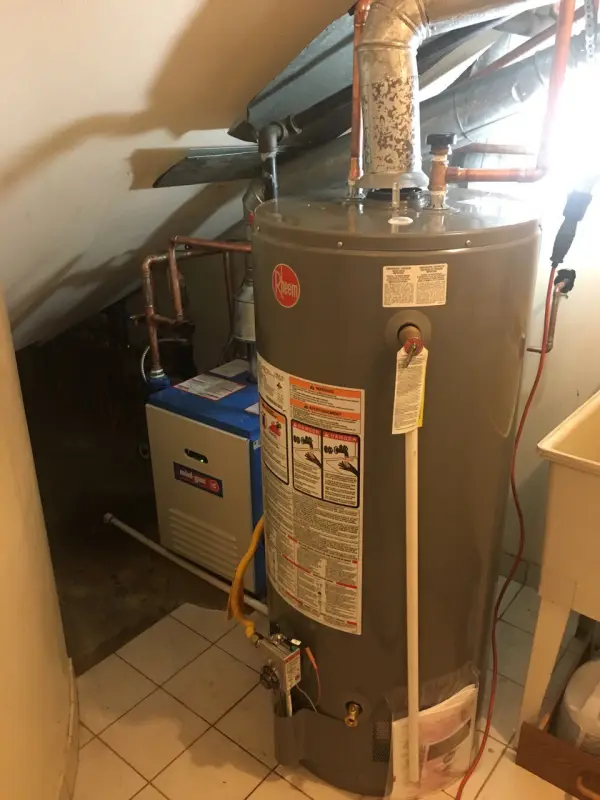
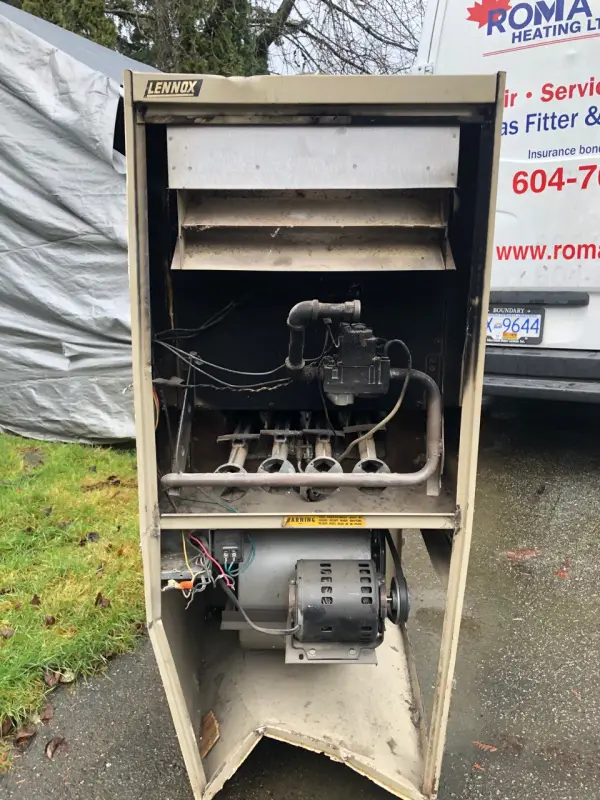
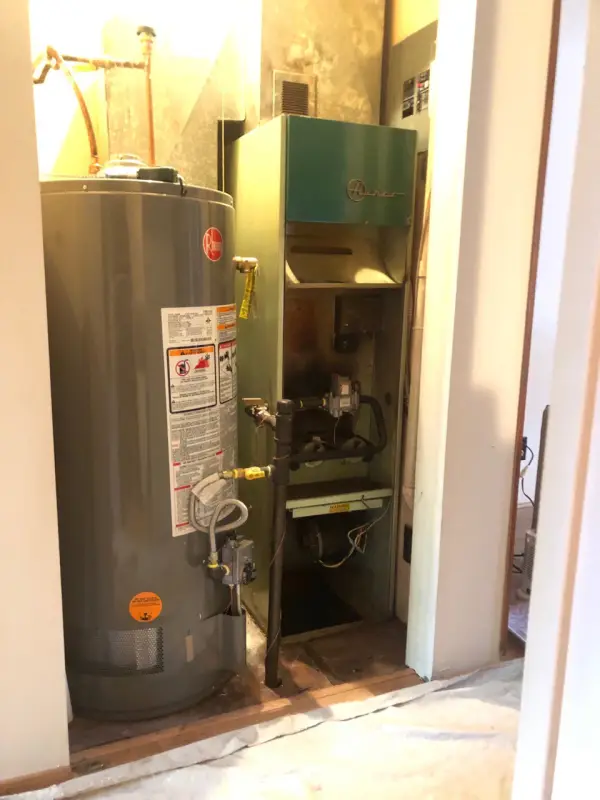
Real ROMA furnace work. These photos are from our own jobs, not stock images. See more in our work gallery or call (604) 704-0300.